


Every parent and teacher hopes to see children grow into confident, creative problem-solvers. Yet, in a world filled with data, tests, and routine, the real challenge is not about teaching kids what to think — but inspiring them to think differently.
One of the most effective ways to do this is through competitions — environments where certainty fades, and imagination must step forward. Children who compete don’t just perform: they transform.
Why Competitions Matter for Children
When a child steps into a contest, several powerful shifts take place. Resilience becomes real as they learn to revisit, rebuild, and retry when initial ideas fail. Teamwork becomes natural, with collaboration, compromise, and conflict resolution emerging through shared problem-solving. Learning gains purpose as geometry, coding, and electronics transform from abstract concepts into tools for tackling real challenges. Inventive confidence blooms as children see themselves not merely as consumers but as creators. And finally, an iterative mindset takes root, where mistakes are seen not as setbacks but as data for improvement. These experiences nurture lifelong skills—far more valuable than any score or rank.
How Avishkaar League 2025 Helps
Avishkaar is bringing the power of hands-on learning to life through the Avishkaar League 2025: Code of Duty — a celebration of creativity, collaboration, and technology. This year’s edition unites three major tracks — IRC League (Robotics & Coding), Makeathon, and Game League — under one thrilling storyline.
At the heart of the League lies the theme “Code of Duty.” In this futuristic narrative, participants become cadets defending the utopian world of Peacehold from a rogue tech force known as The Severance. Teams are challenged to design and build robots, algorithms, and tools to counter threats, secure zones, and reclaim stolen systems. This blend of storytelling and STEM transforms each challenge into a mission, making learning deeply engaging, imaginative, and meaningful.
Recognized as Asia’s largest robotics and coding league for children, the Avishkaar League celebrates innovation and problem-solving at a truly global scale — boasting over 300,000 submissions, 100,000 students, 6,000 schools, and participants from 30+ countries.The IRC League component follows a structured journey, beginning with zonal and state-level rounds from September to December, where teams compete locally before advancing to the International Finale in January 2026. Throughout the process, Avishkaar supports students with webinars, mentorship sessions, and resources to help them plan, prototype, and perfect their creations.
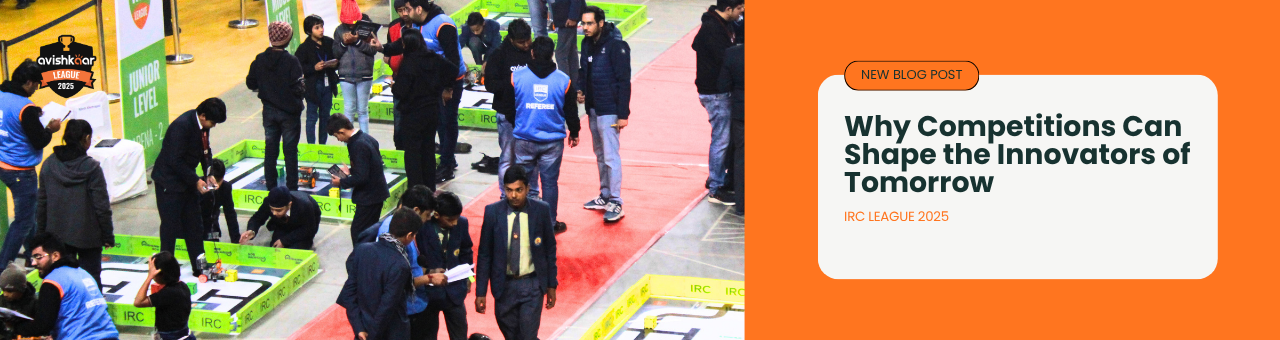
In IRC League 2025, participants use Avishkaar’s advanced robotics kits to build intelligent systems that patrol zones, decode signals, counter enemy interference, and reclaim stolen hubs — all within the dynamic storyline of defending Peacehold. The story-driven format gives every task a purpose: it’s not just about moving a robot, but about solving a mission-critical problem. Students aren’t just competitors — they’re innovators, strategists, and protectors of a digital world.
For parents and teachers, encouraging participation in such a competition means more than just supporting a hobby. It’s about offering children a safe framework to explore, a community of curious minds, and a goal that connects learning with real-world application. Watching a child move from “I can’t” to “I’ll try” — and eventually to “I did it” — is one of the most rewarding journeys for any educator or parent.
Let’s Empower Young Innovators
IRC League isn’t just another contest on a calendar. With Code of Duty 2025, it’s weaving narrative and purpose into STEM challenges. It’s offering children a sandbox to become defenders, creators, detectives of their own future.
And when our children take that first step — building a bot to patrol a zone, decoding an enemy signal, assembling a system under constraints — they begin to see themselves differently. They begin to see possibility.
If you’re reading this as a parent or teacher: plant the seed. Invite a child to think, build, fail, and try again. And watch as they stop waiting for the future — and start creating it.


