


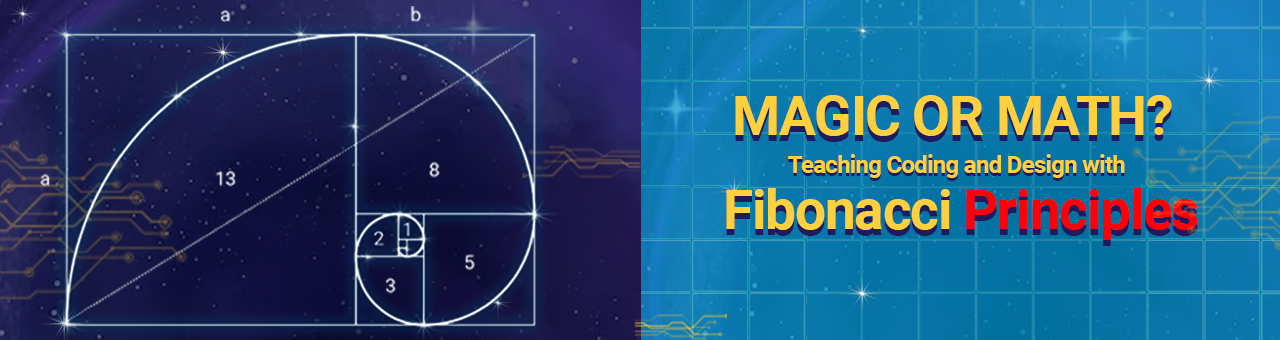
Have you ever noticed the uncanny way in which the Milky Way galaxy and our ears coil in the same pattern?
If you have, it’s not by accident; it’s nature’s design principle, the Fibonacci Principle.
But what is the Fibonacci Sequence?
To recap from sixth grade: it’s a sequence of numbers wherein each number is a sum of the two preceding numbers. It looks something like 1,1,2,3,5,8… By adding 1 and 1, the sum is 2. Adding 1 and 2 gives us 3. Adding 2 and 3 gives us 5…and so on.
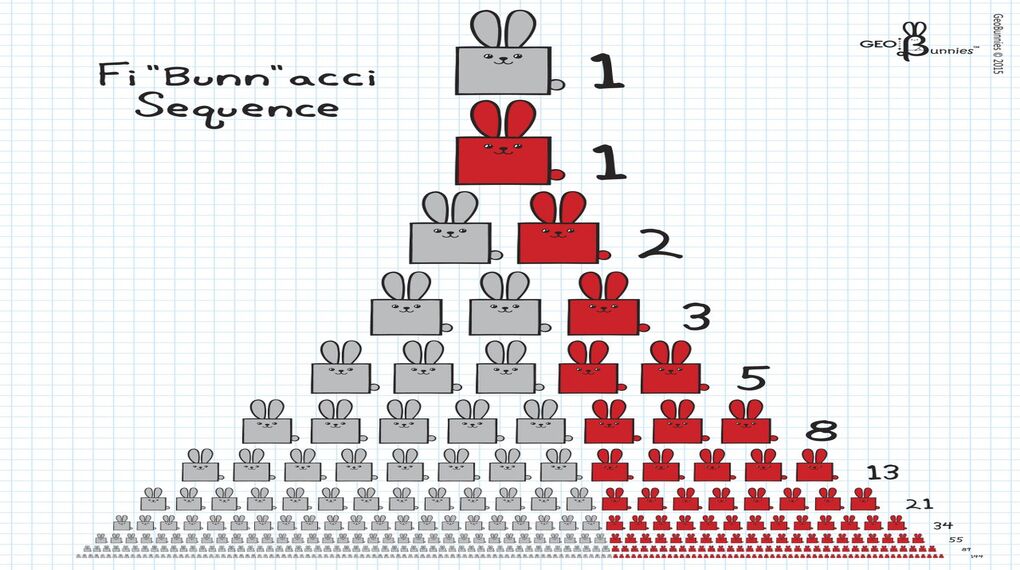
Photo Illustrating the Fibonacci Bunny Problem
Source: https://pin.it/YvoKqnC9Z
As the sequence grows, the golden ratio unveils itself. The golden ratio is approximately 1.618; it’s the ratio of each number to the numbers before it.
(The golden ratio is literally engraved in our DNA!)
And who discovered it?
The number sequence is named after Leonardo Figlio di Bonacci. He was a thirteenth-century mathematician who lived in Pisa, but he did not discover it; he popularised it in the West through his book, Liber Abaci. His efforts have supported Western architectural and art design.
How does the Fibonacci Principle influence coding and robotics design?
Efficient computer algorithms are tested on the Fibonacci Sequence. Since the numbers grow so quickly, the sequence is perfect to push new algorithms to their limit and see how they perform under the stress of large computations. The Sequence is many Python developers' go-to test. It was also a benchmark to test programming languages like Pascal or C in their early days.
In theory, the Fibonacci Principle can also help in designing an efficient robotic hand. If the lengths of segments of the hand progress in the Fibonacci Sequence, the hand and its movements can look more organic or balanced instead of artificial or clunky. The variable segment lengths can reach many positions, even the tighter ones, covering a wide workspace.
What can we Build Using the Fibonacci Principle?
The possibilities are endless. Obstacle course game, Spiral Robot, Golden Ratio Calculator, you name it. All of them can be developed in one platform, the Avishkaar Maker Studio.
Read on to learn how:
1) The Golden Ratio, in Motion
This Golden Ratio Calculator responds to your hand in real time—and yes, it’s as cool as it sounds. Using a simple setup made with Avishkaar parts and a short code built in Avishkaar Maker Studio, your hand movement can turn into a live Fibonacci-and–golden ratio visualizer.
Move your hand away, and the Fibonacci numbers (and their ratios) start climbing. Bring your hand closer, and the sequence winds back down.
It’s Maths on your fingertips.
Watch how you can also build this interactive calculator here:
2) The Fibonacci Obstacle Run Game
To develop this game, you just need to integrate the Fibonacci sequence into your loop code.
Pss…what is a loop code?
To put it simply, loop coding is when a computer repeats a set of instructions until a condition is met. The Fibonacci Sequence fits perfectly into this because when we integrate it into the loop, we can learn how variables update and how patterns evolve in complexity. But if you don’t want your coding journey to grow in complexity, AMS block coding can keep it breezy.
Now, in the Game Builder Mode in Avishkaar Maker Studio, create 3 variables:
fib1 → set to 1 (last fibonacci no.)
fib2 → set to 1 (current fibonacci no.)
fib3 → set to 0 (next one to be calculated)
With every new wave of obstacles, the game will set the obstacle’s speed using the current Fibonacci value. Then, using basic math blocks, it will add the two previous values to get the next one, shift the variables forward, and the process will be repeated inside a loop. Just like that, your game will automatically follow the sequence—1, 1, 2, 3, 5, 8…
So at first, an obstacle can appear every 1000 milliseconds, then every 500 milliseconds, and soon every 333 milliseconds as the game speeds up. This loop will make the spawn gap shrink as the Fibonacci sequence progresses.
Why not make it Squid Game themed while you’re at it?
Red Light, Green Light: The movement window can follow Fibonacci time units, and the freeze can also follow the same pattern, or it can follow an inverse pattern. So,
Freeze→ 0.1s → 0.1s → 0.2s → 0.3s → 0.5s…
Movement→ …0.5s → 0.3s → 0.2s → 0.1s → 0.1
3) Score Like a Pro: When Small Wins Turn Into Big Rewards
Instead of handing out random points, you can let the Fibonacci sequence control the reward system, too. Each successful dodge doesn’t just add one flat score. It grows with the pattern: the first dodge gives you 1 point, the next also gives you 1, then 2, then 3, then 5… and suddenly every move feels far more rewarding than the last.
To make your gameplay truly addictive, you can make both the obstacle difficulty and the rewards grow in the Fibonacci Sequence.
It’s kind of crazy how one simple pattern shapes so much of human life. Gives you a reason to study Maths.
But don’t worry, it doesn’t have to be textbook boring. With the right tools and some Avishkaar magic, it can inspire play and turn learning into pure fun.
Ready to let numbers run the show?


