


TL;DR
- Yes, it qualifies. A robotics lab in a government school counts as "promotion of education" under Schedule VII (ii) of the Companies Act, 2013, so it is eligible CSR spend.
- The school owns the lab, not you. Kits and furniture are capital assets, and CSR Rule 7(4) requires a public authority, beneficiary or registered non-profit to hold them.
- Implement directly or through a registered partner. If you use an NGO, it must hold a CSR-1 registration number; kit suppliers sell to you or that partner.
- Budget for people, not just kits. Teacher training and multi-year support decide whether the lab gets used; structure phased rollouts as an "ongoing project" of up to three years after the start year.
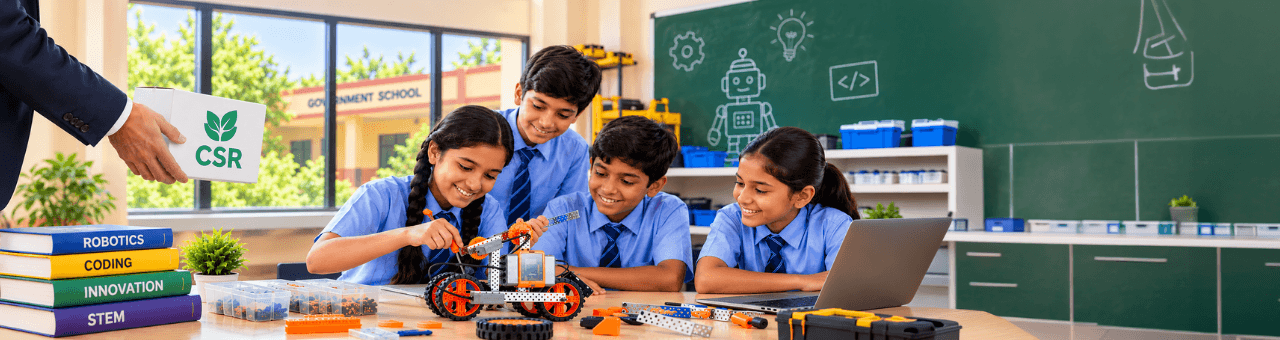
Yes — your company can use its CSR budget to set up a robotics lab in a government school, because Schedule VII of the Companies Act, 2013 lists the promotion of education as an eligible CSR activity. The lab delivers results when you fund it as a multi-year education program — kits, curriculum, teacher training and support — and hand it to the school as the asset owner, rather than as a one-time equipment donation.
Below: who must spend CSR, the rules that shape a school lab, a seven-step setup process, budget lines and FAQs. Legal points come from the Companies Act, 2013 and the CSR Rules as amended up to May 2026; planning advice reflects common practice. Confirm details with your company secretary or CSR counsel before committing funds.
Can CSR funds pay for a robotics lab in a government school?
Yes. Item (ii) of Schedule VII covers promoting education, especially among children. A robotics and coding lab in a government school sits squarely inside that item.
Section 135(1) of the Companies Act decides whether your company must spend CSR at all. Meeting any one threshold in the preceding financial year triggers the obligation:
| Criterion (preceding financial year) | Threshold that triggers CSR |
|---|---|
| Net worth | ₹500 crore or more |
| Turnover | ₹1,000 crore or more |
| Net profit (computed under Section 198) | ₹5 crore or more |
A covered company must spend at least 2% of its average net profit for the three immediately preceding financial years (Section 135(5)). Example: a company with an average net profit of ₹40 crore has a minimum CSR obligation of ₹80 lakh for the year. If the obligation is ₹50 lakh or less, the Board can perform the CSR Committee's functions (Section 135(9)). The exception: a company with any balance in its Unspent CSR Account must constitute a CSR Committee (Rule 3(1), as amended in 2022). A multi-year lab project can create such a balance, so check this before you plan an ongoing project.
The Corporate Laws (Amendment) Bill, 2026, introduced in Lok Sabha on 23 March 2026, proposes raising the net-profit trigger to ₹10 crore (or another amount the government may prescribe). A Joint Parliamentary Committee reported on it on 3 August 2026; as of late October 2026 it has not been passed. Until it is enacted and notified, plan against the current thresholds.
Robotics also fits national curriculum direction. Paragraph 4.25 of NEP 2020 says activities involving coding will be introduced in the Middle Stage (Grades 6–8), and a CSR-funded lab gives a government school the hardware and trained teachers to deliver them.
Which CSR rules apply to a robotics lab in a government school?
Six provisions of the Companies Act and the CSR Rules (as amended up to May 2026) shape how you fund, implement and report a school lab. This is general information, not legal advice; check your case with your company secretary.
| Rule | What it requires | What it means for your lab project |
|---|---|---|
| Rule 7(4) — capital assets | CSR-funded assets must be held by a Section 8 company or registered trust or society with a CSR registration number, the project's beneficiaries, or a public authority | Hand kits, furniture and devices to the school or education department in writing; they cannot sit on your books. |
| Rule 4(1) — implementing agency | An outside implementing agency must be registered with the government through Form CSR-1 and fall into a permitted category: for example, a Section 8 company or registered public trust or society with 12A and 80G registration (or a specified Section 10(23C) exemption plus 80G), a government-established entity, or a statutory body. An agency your company did not set up needs a three-year track record in similar work. | Ask your NGO partner for its CSR registration number and its income-tax registrations before signing. A kit supplier is a vendor you or your partner buy from, not an implementing agency. |
| Rule 7(1) — administrative overheads | General management and administration of CSR cannot exceed 5% of the year's total CSR spend | Your internal CSR team's time and admin costs count against this cap. |
| Section 135(6) and Rule 2(1)(i) — ongoing projects | Runs up to three years after its start year; unspent money moves to an Unspent CSR Account within 30 days of year-end, to be spent within three financial years | Fits a phased multi-school rollout. Unspent money on other projects goes to a Schedule VII fund within six months. |
| Rule 8(3) — impact assessment | Companies with an average CSR obligation of ₹10 crore or more must commission an independent impact assessment of projects of ₹1 crore or more, at least a year after completion. The assessment's cost can be booked as CSR spend up to 2% of that year's total CSR expenditure or ₹50 lakh, whichever is higher. | Collect baseline data in year one so the later assessment has a comparison point. |
| Rule 9 — website disclosure | The CSR Committee's composition, the CSR policy and Board-approved projects go on the company website | Your lab project becomes public; agree the description with communications. |
The CSR Committee's composition, the CSR policy and Board-approved projects go on the company website
Your lab project becomes public; agree the description with communications.
How to set up a robotics lab in a government school using CSR: 7 steps
A government-school lab moves through seven stages. Steps 1 and 7 follow from the CSR Rules; steps 2–6 are common practice and vary by state and school.
- Get the project into your annual action plan. The CSR Committee recommends an annual action plan and the Board approves it (Rule 5). Name the project, the schools or district, the implementation route, the budget, the timeline and how you will monitor it.
- Choose schools with the education department, not around it. Start with the district education office, the state school education department, or the Ministry of Education's Vidyanjali portal. Approval rules differ by state. In Delhi, for example, an October 2025 circular lets heads of government and aided schools accept Vidyanjali proposals directly, requires Directorate of Education permission for major or high-value projects, and requires all CSR proposals to come through the Vidyanjali portal.
- Decide how you will implement. Run it yourself, or through a CSR-1-registered NGO with education experience. The comparison table below sets out the trade-offs.
- Survey the site. Check for a lockable room, stable power points, storage, and internet access if the curriculum runs on cloud software. Fixing a room late delays everything else.
- Match kits and curriculum to grades. Younger students need snap-fit kits; older students need programmable controllers and text-based coding. Avishkaar's school portfolio, for example, steps from Tweak (Grades I–II) to the MEX Robotics PRO Kit (Grades III–IV), the ER Series (Grades V–VIII) and the IoT Starter Kit (Grades IX–XII).
- Train teachers before students arrive. Schedule hands-on training for at least two teachers per school, so the lab survives a transfer. Add refresher sessions each term.
- Hand over the asset and set up reporting. Sign a handover letter or MoU naming the school or department as owner, as Rule 7(4) requires. Keep an asset register, and agree a simple monthly usage report: sessions held, students reached, projects built.
What should a CSR budget for a school robotics lab include?
A complete budget has nine lines; the ones after the kits decide whether the lab is still in use in year three. Costs vary with student numbers, grades and devices, so treat this as a checklist, not a price list.
| Budget line | What it covers | Why it matters |
|---|---|---|
| Robotics kits and spares | Kits sized to batch size, plus motors, sensors and batteries for wear | A worn motor or lost sensor can sideline a whole kit |
| Lab furniture and storage | Work tables, lockable cabinets, labelled bins | Parts that go missing make kits unusable |
| Computers or tablets | Devices for block-based and text coding | Coding sessions need a device per pair or small group |
| Curriculum and software | Grade-wise lesson plans, LMS or coding platform licences | Teachers need ready lessons mapped to the timetable |
| Teacher training | Initial training plus termly refreshers | In practice, trained teachers decide whether the lab gets used |
| Trainer or mentor support (optional) | Visiting or resident trainer for the first months | Bridges the gap while school teachers build confidence |
| Student competitions | Entry fees, travel for inter-school events | Gives students a goal beyond the classroom |
| Monitoring and impact assessment | Baseline survey, usage tracking, independent assessment where Rule 8(3) applies | Proves outcomes to your Board; where an assessment is mandatory, its cost can count as CSR spend up to 2% of the year's CSR expenditure or ₹50 lakh, whichever is higher |
| Programme management | Your CSR team's administration | Counts toward the 5% overhead cap |
For a hardware reference point, take the Avishkaar Robotics Classroom Bundle: 400+ parts, 500+ possible robot builds, a FULL 2.0 controller with four motor and five sensor ports, and block-based coding plus app control, for ages 8+. Full school lab programs are quoted per project, so ask for a costed proposal rather than multiplying list prices.
Should you implement directly or through an NGO partner?
Both routes are legal under Rule 4(1); the right one depends on your team's capacity on the ground. The trade-offs below are practical judgement, not regulatory requirements.
| Factor | Direct implementation | Through a CSR-1-registered implementing agency |
|---|---|---|
| Control over vendors and quality | Full — you contract the solution provider yourself | Shared — the agency usually procures, within terms you set |
| Field presence | You need staff or a vendor to visit schools | The agency brings local teams and government relationships |
| Compliance checks | Your team handles them | Verify the agency's CSR registration number and track record |
| Fund flow | You pay vendors directly | You release funds in tranches; the agency reports utilisation |
| Best for | One to a few schools near your offices | District-scale rollouts or new geographies |
Either way, the solution provider supplies kits, curriculum, training and support, and reports usage to you or your partner.
What keeps a government-school robotics lab in use after year one?
A lab stays active with a timetable slot, trained teachers, a reason to build, and someone fixing what breaks. These five practices come from lab rollouts, not regulation:
- A fixed timetable period. Ask the head of school to assign at least one weekly lab period per participating grade, mapped to the Middle Stage (Grades 6–8) coding activities NEP 2020 calls for.
- Two trained teachers, not one. Government teachers transfer; a second trained teacher keeps the lab open.
- A goal beyond class. Inter-school competitions give students deadlines and an audience. Avishkaar League, for instance, runs robotics, making and coding challenges for school teams each year.
- A spares and repair channel. Agree in advance who replaces broken parts and how fast.
- Usage data every month. Track sessions held, students attending and projects completed. It catches a stalled lab early and feeds your CSR report.
Some providers bundle these into one program. Avishkaar Innovation Labs, for example, combine lab design, a Grades I–XII curriculum that Avishkaar maps to NEP 2020 and NCF, teacher training with a certified-trainer track, competitions and technical support. Students progress from drag-and-drop coding to Python on the cloud-based Avishkaar Maker Studio, and senior grades can move into electronics with boards such as the Maker Board 3.0. Avishkaar reports reaching 300,000+ students in 6,000+ schools across 30+ countries.
When is a robotics lab the wrong CSR choice?
A robotics lab is not every school's right first investment. Fund something else first if any of these apply:
- The school lacks basics. Without reliable electricity, a secure room or adequate classrooms, fund those first; a lab cannot run without them.
- No teacher can be assigned. If the school cannot name teachers for training, the kits will likely stay in cupboards.
- The budget covers only one year. Kits without follow-up training and support rarely change learning outcomes. Commit to a multi-year ongoing project or choose a smaller scope.
- The goal is a launch photo. A handover ceremony is not an outcome. Your Board, and any later impact assessment, will ask what students learned.
Plan your CSR robotics lab with Avishkaar
Planning a robotics lab in a government school, or across a district, under this year's CSR budget? Contact Avishkaar's school programs team at home.avishkaar.cc for a costed lab proposal, grade-wise curriculum mapping and a teacher-training schedule. To see the hardware first, explore the Robotics Classroom Bundle and other kits at shop.avishkaar.cc.
Frequently Asked Questions


